

Overview & Identification

For the course DHM 280 in Spring 2023 at West Chester University, we were assigned to identify a discipline and relate it to the interdisciplinary field of digital humanities. For our project we selected the discipline Film Studies and then defined it, selected a project, scholarship and aligned the goals and values of Film Studies and the Digital Humanities.
What is Film Studies?
Film studies is an academic discipline that focuses on the study of films, cinematic history and film culture and is majorly informed by film theory. Although film feels like a new media in culture it dates back 150 years. Experts in Film studies focus on studying cinema that analyzes the content of a film, looking into its form, the narrative, technique, stylistic elements, and the historical, socio-political, economic, cultural aspects and context surrounding it. In simpler terms, film studies gives the ability to analyze, understand, and appreciate the moving image by acknowledging the historical, political, socio-cultural, and other critical approaches to film.

Project: Visualizing Colour Palettes in Film
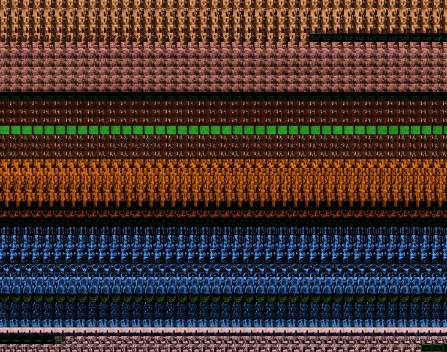
Visualizing Colour Palettes in Film uses ImagePlot (visual analytics software) to break down each of the films collected from the Desmet collection into image sequences consisting of all the films’ individual frames, producing image sequences of over 100,000 images. From these sequences, they created different types of visualizations so as to find out which kinds of patterns each film would reveal.
What the product is, is a photo consisting of all different types of color patterns that were derived from individual frames, allowing users to see all the different color schemes used to show different tone-switches and structure within the films.
Scholarship
“A Digital Humanities Approach to Film Colors”

In the framework of the research project FilmColors funded by an Advanced Grant from the European Research Council (ERC) a range of computer-assisted methods are developed and applied to investigate the relationship between color film technology and aesthetics. A large group of four hundred films ranging from the invention of cinema to the mid-1990s is being investigated by a combination of a video annotation tool and a structured protocol provided by a custom-made film analysis database. These human-based analyses are then being extended by (semi)automatic tools that apply deep learning and neural networks to extract meaningful color schemes from the films. Ultimately these tools will be integrated into an online crowdsourcing platform for the analysis of color films. By publishing the sources and the results of the research project on the Timeline of Historical Film Colors—a comprehensive resource for all topics related to film colors—the outcome of the research project will be available to researchers, film archivists, and the general audience interested in the topic.
Flueckiger, Barbara. “A digital humanities approach to film colors.” Moving Image: The Journal of the Association of Moving Image Archivists 17.2 (2017): 71-94.
Tool for Film Studies: ImagePlot

Image plot is a software tool that allows us to visualize collections of images and videos of any size. ImagePlot’s visualizations shows the actual images in your collection. The images can then be scaled to any size and organized in any order.
How does ImagePlot work? First, you start with point and line graphs, which allow you to quickly explore your image set. Once you find an interesting pattern you can, re-render the plot to show the images. ImagePlot then allows you to go back and forth between these options as often as you like.
Goals of Film Studies & Digital Humanities
One goal of film studies is to better understand film, this goal relates to our chosen project because they focused on linking the results to the demonstrator’s interface to stimulate ways of using mapping and film visualization in combination. In addition a goal of the digital humanities is to analyze and interpret cultural data. These two goals align because the project uses mapping and film visualization to be able to have a deeper understanding of the results and to allow others to interpret the cultural data of film. Understanding and interpreting the cultural data of film is important because it allows us to critically think about film and its relation to culture, history, and technology. Having a better understanding of film and the digital humanities allows us to connect with others, study data of film visually and share the importance of both disciplines.

Values of Film Studies & Digital Humanities
The main value that aligns between the discipline of film studies and digital humanities is diversity.
Diversity is the practice of involving people from wide ranges of cultural and ethnic backgrounds, genders, sexual orientations, areas of interest, skills, experiences, etc.
Diversity is critical in the area of film studies considering many films that are analyzed and studied are created from different cultural backgrounds and experiences. Without this variety within the discipline, it would be nearly impossible to accurately study/analyze certain films given there’s no type of context or background information surrounding culturally-driven motives or issues that only apply to certain groups of people.
Within digital humanities, diversity is of the same level of necessity. “Digital Humanities must take active strides to include all the areas of study that compromise the humanities and must strive to include participants of diverse age, generation, skill, race, ethnicity, sexuality, ability, nationality, culture, discipline, areas of interest. Without open participation and broad outreach, the digital humanities movement limits its capacity for critical engagement.” (THATCamp SoCal)
Values Within Digital Humanities

Conclusion & Evaluation
The same way that art study and analysis has become a quintessential discipline which allows us to understand the evolution of cultures in specific areas, so too has film study and analysis become equally as important. Film study and analysis allows us to understand the development of media. The Digital Humanity which we are analyzing allows us to fully see the relation between color patterns, color scheme, and tone within film sequences. By seeing this we can infer how these films’ macroscopic patterns relate to the greater whole of the film. These macroscopic images become their own unique form of modern artwork. This study excellently demonstrates a significant cultural figure’s studies and works, such as Jean Desmet, while merging that knowledge with a digital framework. We can see new patterns and variations in his works by giving computer renderings of his works on a macroscopic scale.

Our Team: The Digital Weapons

- Madison Johnston
- Maddie is a freshman at WCU and is studying Media and Culture.
- Roles: Defining tools, identifying goals of Film Studies and Digital Humanities and slideshow builder.
- Paul Foley
- Paul is a sophomore at WCU and is studying English.
- Roles: Locating and defining our project, identifying values of Film Studies and Digital Humanities, and report writer.
- Juliana Janssen
- Juliana is a junior at WCU and is studying Interdisciplinary Studies.
- Roles: Writing overview, defining discipline, identifying goals of Film Studies and Digital Humanities, and Webpage builder.
- Dante Barnes
- Dante is a third year at WCU, who has hopes of becoming a sports marketer one day.
- Roles: Locating and explaining a scholarship related to the fields and identifying values of Film Studies and Digital Humanities.
- Taylor Montgomery
- Taylor is a third year at WCU with a major in Media and Culture
- Roles: Locating a scholarship related to the fields, putting together a conclusion, and an evaluation.
